Accelerating Medical Discovery and Reframing the Biosafety Risk Landscape
Researchers, students, and practitioners from across the University registered to attend the three Distinguished Speaker Series events NNCI hosted in May
AI is rapidly restructuring how clinicians collect, interpret, and act on real-world data, compressing timelines that have historically slowed both research and care delivery. At the same time, AI-powered biomedical research and laboratory robotics impacts biosafety and biosecurity oversight, including the continuing responsibility of investigators to conduct thorough risk assessment and mitigation.
More than 115 researchers, students, and practitioners registered to attend two recent events exploring these themes, hosted by the Northwestern Network for Collaborative Intelligence (NNCI).
Through the Distinguished Speaker Series, NNCI sparks interdisciplinary and cross-functional dialogue and illuminates emerging ideas around responsible and high-impact research and education in data science and AI.
“The pace of change in biomedical AI can feel overwhelming, but bringing together researchers, clinicians, and policymakers helps us identify the most promising paths forward and the risks we cannot afford to overlook,” said Abel Kho, professor of medicine and preventive medicine at Northwestern University Feinberg School of Medicine and director of the Institute for Artificial Intelligence in Medicine.
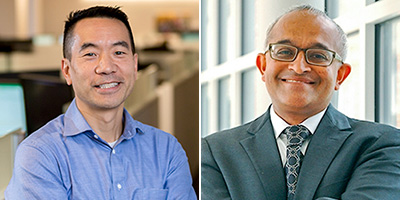
Kho and V.S. Subrahmanian are the founding codirectors of NNCI. Subrahmanian is the Walter P. Murphy Professor of Computer Science at Northwestern Engineering, faculty fellow at the Northwestern Roberta Buffett Institute for Global Affairs, and director of the Northwestern Security and AI Lab.
“From accelerating medical discovery to rethinking biosecurity frameworks, the implications of AI in the life sciences are vast. We are proud to bring these critical conversations to Northwestern,” Subrahmanian said.
Towards Virtual Patient: AI for Accelerating Medical Discovery
At NNCI’s Distinguished Speaker event on May 19, Hoifung Poon discussed the untapped potential of synthesizing population-scale, routinely collected clinical data— imaging, clinical notes, genomics, and more—to accelerate medical discovery through AI-powered simulated clinical trials at a fraction of the time and cost.

Poon, the general manager of real-world evidence at Microsoft Research, is a leading figure in biomedical AI and precision health whose influential academic career and recent industry innovations have helped shape modern approaches to medical data understanding and generative medicine. Poon’s team is advancing multimodal generative AI to create a virtual patient world model as a digital twin for forecasting disease progression and treatment response across populations.
During his talk, Poon explained that AI’s biggest near-term impact is productivity, not discovery. While “automating discovery” remains aspirational, he said, meaningful transformation is already occurring by automating tedious clinical and research workflows.
AI & Biosecurity
For NNCI’s Distinguished Panel event on May 28, the panel explored how AI is actively reshaping the life sciences, accelerating discovery, expanding capabilities, and introducing new categories of biosecurity risk that challenge existing models of oversight. Mohammad Hosseini, assistant professor of preventive medicine (Biostatistics and Informatics) at Northwestern University Feinberg School of Medicine, moderated the discussion with Doni Bloomfield, associate professor of law at Fordham Law School; Daniel Eisenman, executive director of biosafety services at Advarra; and Nicole Kikendall, principal biologist at Argonne National Laboratory.

Stressing that the technological inflection point is already here versus some distant hypothetical, the panelists noted how AI is unlocking unprecedented scientific capabilities, but introduces equally serious risks, especially in high-stakes biological domains.
The panel also discussed how traditional regulatory frameworks—largely designed to control physical materials, agents, and laboratory environments—are increasingly misaligned with a landscape defined by digital infrastructure, data flows, and distributed expertise.