Advancing AI for Impact, from Forest Canopies to Speech Recognition
NNCI’s Summer Speaker Series welcomed Meta’s Madeline Hinkamp and Technion’s Yossi Keshet
Modern AI models enable smarter technology and broader impact. From decoding speech production and perception to mapping the planet’s forest canopies, researchers are using open-source AI models to tackle problems across emergency response, environmental science, public health, and scientific discovery.
More than 85 researchers, students, and practitioners attended two recent events exploring these themes, hosted by the Northwestern Network for Collaborative Intelligence (NNCI).
Through the Summer Speaker Series, NNCI welcomed the public to hear from leading voices in AI, data science, and technology as they share insights, experiences, and emerging trends shaping the future.
"What stood out across both talks was the importance of translating technological advances into real-world impact,” said Abel Kho, professor of medicine and preventive medicine at Northwestern University Feinberg School of Medicine and director of the Institute for Artificial Intelligence in Medicine. “Whether improving speech technologies or enabling new approaches to conservation and public health, AI reaches its fullest potential when it helps solve meaningful problems that affect people's lives."
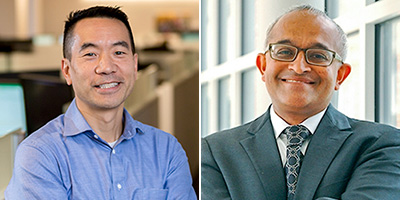
Kho and V.S. Subrahmanian are the founding codirectors of NNCI. Subrahmanian is the Walter P. Murphy Professor of Computer Science at Northwestern Engineering, faculty fellow at the Northwestern Roberta Buffett Institute for Global Affairs, and director of the Northwestern Security and AI Lab.
"The rapid progress we are seeing in AI is being driven not only by advances in algorithms, but also by the growing availability of models, data, and computational resources that enable innovation at scale,” Subrahmanian said. “These talks highlighted how open and collaborative research ecosystems can accelerate discovery across diverse domains."
AI for Good: Open Models Driving Real-World Impact
At NNCI’s August 4 Summer Speaker Series event, Madeline Hinkamp discussed how open-source AI and public data products are reshaping how communities, governments, nonprofits, and researchers harness AI responsibly to address real-world challenges.

Hincamp, a program manager at Meta's AI for Good team, outlined how Meta's open-weight computer vision models are being fine-tuned and deployed by researchers at scale across a wide range of domains. She highlighted a first-of-its-kind global canopy height map built with the World Resources Institute; an endangered-species monitoring dataset developed with Conservation X Labs; a lightweight medical imaging model deployed in resource-limited clinics; and Boxcrete, a carbon-reducing concrete formula developed with the University of Illinois Urbana-Champaign and Amrise.
Across nearly every use case, Hincamp explained, the availability of training data remains the single biggest bottleneck. Another major constraint is running computer vision models in real time on edge devices, or hardware like sensors, smart cameras, or routers that process data locally rather than sending raw data back to a central server.
Key Advances in Speech Technology in the Last Five Years
NNCI’s August 11 Summer Series event was co-hosted by Professor Matthew Goldrick and the Cognitive Science Program. Guest speaker Yossi Keshet traced the leap in speech recognition technology to advances in scale. Keshet explained that, while OpenAI’s Whisper launched a revolution in 2022, the platform used the same transformer architecture researchers already had; the difference was the sheer volume of supervised training data.
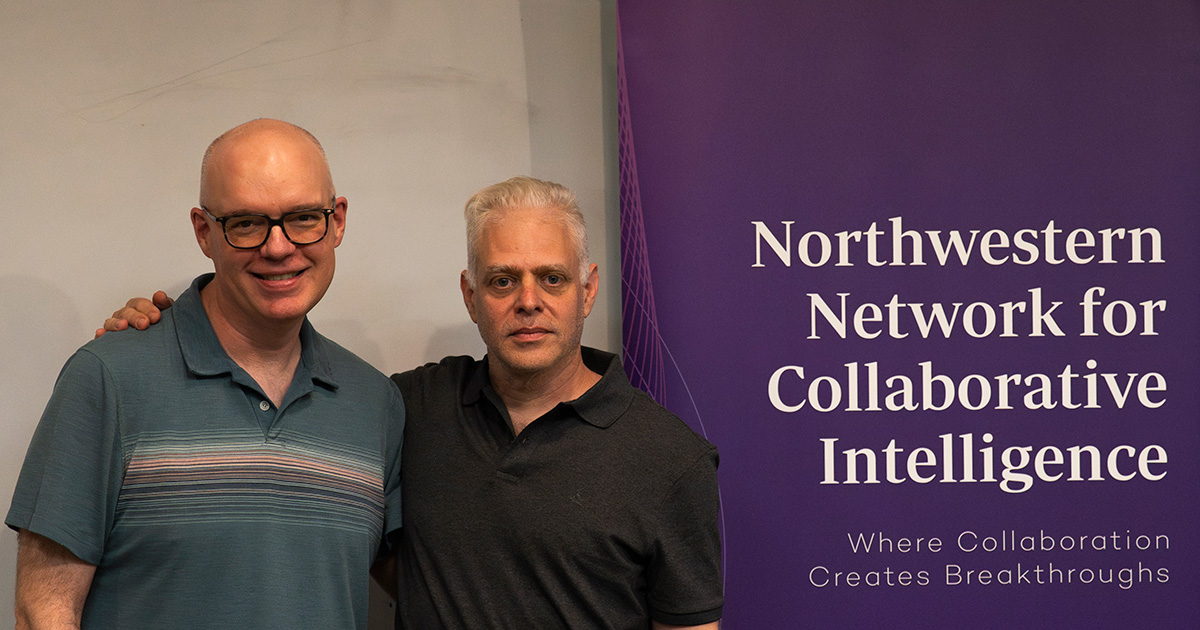
Keshet is associate professor of electrical and computer engineering at Technion - Israel Institute of Technology, where he runs the Speech, Language, and AI Lab. He discussed his lab's recent work on speech synthesis, including DiTAR, a diffusion-based text-to-speech model that can generate expressive features like creaky voice across long stretches of speech. He also described his team's work on speculative decoding that speeds up transcription by roughly 50 percent. When comparing systems like Whisper against human listeners on noisy audio, Keshet noted that the AI system transcription can outperform humans.