Convening Leading Voices in Data Science and AI
The Northwestern Network for Collaborative Intelligence Distinguished Speaker Series launched this month with events featuring Inderpal Bhandari and Judge Xavier Rodriguez
The Northwestern Network for Collaborative Intelligence (NNCI) is a community of experts dedicated to advancing responsible, high-impact, world-class research and education in data science and AI. By harnessing Northwestern’s unparallelled interdisciplinary culture and uniting the strengths of the University’s top schools, NNCI is building dynamic partnerships around and beyond campus.
In support of this mission, NNCI recently launched a Distinguished Speaker Series to convene leading voices in data science and AI. The keynote talks and expert panels illuminate emerging ideas, foster interdisciplinary dialogue, and examine how these fields intersect with diverse domains of study. The first hybrid event, held in January 2026, marked the beginning of this yearlong series.

“NNCI’s Distinguished Speaker Series is intended to generate enthusiasm for the development and use of AI across disciplinary boundaries,” said V.S. Subrahmanian, Walter P. Murphy Professor of Computer Science at Northwestern Engineering, faculty fellow at the Northwestern Roberta Buffett Institute for Global Affairs, and director of the Northwestern Security and AI Lab. “Not only can faculty, staff, and students come together to attend these lectures, they can use the opportunity to form multidisciplinary collaborations.”
Subrahmanian and Abel Kho are the founding codirectors of NNCI. Kho is a professor of medicine and preventive medicine at Northwestern University Feinberg School of Medicine and director of the Institute for Artificial Intelligence in Medicine.
“Through timely and thought-provoking discussions, we aim to help faculty, staff, and students build connections, spark new ideas, and build communities working together to tackle some of societies biggest challenges,” Kho said.
AI in sports – from discovery to disruption
For the inaugural event on Jan. 13, NNCI welcomed Inderpal Bhandari to discuss the evolution of AI in sports. More than 80 guests registered to attend in person or virtually. Bhandari, IBM’s former global chief data officer and member of the board of directors for the AES Corporation and Walgreens Boots Alliance, has charted AI’s evolution for decades. Previously, he pioneered an early example of augmented intelligence technology for the NBA. The system helped uncover patterns in game data to support coaching decisions and laid the foundation for how data and AI are used in sports today.
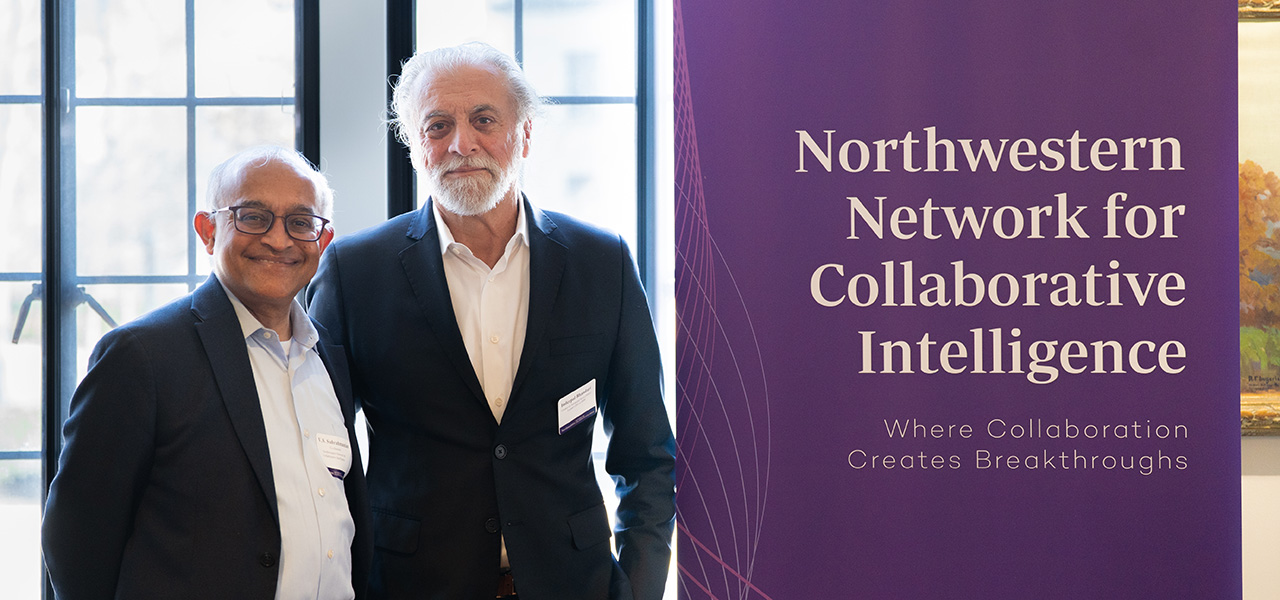
During his talk, Bhandari explored the current landscape and future potential of machine learning, computer vision, and generative AI systems—from tracking player movement and preventing injuries to personalized training and optimizing team strategy to enhancing the fan experience. He explained that near real-time, moment-by-moment AI feedback is already influencing gameplay, raising competitive thresholds and encouraging more creative and adaptive play.
Drawing from his AI research expertise and corporate enterprise leadership experience, Bhandari also discussed how AI is operationalized at scale. He suggested that cultural and organizational change is harder to tackle than technical development. Trust, mindset shifts, and adoption can be the biggest barriers to success, underscoring the need for transparent and explainable AI systems that allow human users to understand, interpret, and trust the recommendations made by machine learning models. Bhandari also noted that, even as AI systems become increasingly optimized and perceptive, the human role remains essential—creativity, judgment, and agency are not displaced by automation.
AI in the Judiciary
On Jan. 20, NNCI and Northwestern’s Law and Technology Initiative co-hosted the second Distinguished Speaker event featuring Hon. Xavier Rodriguez, US District Judge of the Western District of Texas, San Antonio Division. Daniel W. Linna Jr., senior lecturer and director of law and technology initiatives at Northwestern, moderated the discussion, which more than 235 guests registered to attend.

Offering a pragmatic and cautionary view of AI’s role in the courts, Rodriguez highlighted its potential to dramatically accelerate judicial analysis without overriding judicial judgment. Based on his experience overseeing complex voting rights litigation, Rodriguez described how AI tools can synthesize complex records in seconds—work that traditionally took months. At the same time, Rodriguez was clear about the limits—and risks—of deploying AI in judicial settings. He distinguished between appropriate low-risk, high-value uses of AI—such as preparing for hearings, identifying contested issues, and organizing records—and applications he views as too risky, such as delegating dispositive rulings. He stressed the importance of using AI as analytical rather than a decision-making tool.
Emphasizing human accountability and professional responsibility, Rodriguez cautioned that AI systems are nondeterministic and require transparency and human oversight. Because generative AI tools can produce different outputs from the same prompt, he stressed the need for judicial skepticism and verification. Finally, Rodriguez warned that deepfakes pose a serious threat to evidentiary integrity and public trust in the courts. He expressed deep concern about AI-generated audio and video undermining confidence in evidence, noting that litigants are already arguing that authentic evidence could be fabricated.