FORGE Student Spotlight: Kanagha Santhoshini Sivakumar
Sivakumar’s FORGE team developed ChildVoice, an audio speech model that separates children’s voices from adult examiners in speech assessment recordings, giving researchers the clean data they need to build earlier screening tools for speech disorders
Northwestern Engineering’s Kanagha Santhoshini Sivakumar builds AI speech recognition tools and pipelines to aid in diagnosis associated with child speech-language pathology.
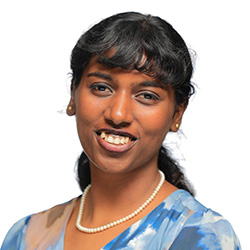
A student in Northwestern Engineering’s Master of Science in Artificial Intelligence (MSAI) program with a background in software engineering, Sivakumar is a member of the Pediatric Speech Technologies and Acoustics Research (PedzSTAR) Lab, directed by Professor Marisha Speights.
Aiming to bridge the gap between her domain expertise and applied AI technologies, Sivakumar joined the inaugural FORGE cohort this summer. FORGE is an initiative of Northwestern’s Network for Collaborative Intelligence (NNCI). It serves as a hub for AI innovation, hands-on experimentation, and interdisciplinary problem solving. Working alongside Northwestern faculty, staff, and external partners, student teams work directly on high-impact problems, developing prototypes, analytical models, proof-of-concept demonstrations, and exploratory research findings.
Sivakumar worked with FORGE team members Sophie Liu, an undergraduate student studying mathematics and computer science, and Jack Peterson, a medical student at Northwestern University Feinberg School of Medicine. Together with Speights and alum Bharath Yedla (MS ’25), they developed ChildVoice, an audio model that separates a four-year-old’s speech from that of the adult administering a speech and language test. The isolated recordings form a dataset that researchers can use to build automated tools that detect speech disorders earlier.
Describe the project you worked on through FORGE. What was the problem you were trying to solve?
The PedzSTAR Lab has a wealth of speech and language test data which is extremely diverse, representing a lot of kids from different backgrounds and cities. Unfortunately, much of that raw data is not usable because it's filled with adults speaking over the children during the testing.
The focus was to make this data usable. How do we clear out all the adult speech, extract just the child speech, and give a clear mapping for how the screening tool can be used for future diagnostic systems? We created a corpus-building tool that can be adapted based on your downstream task. We built a pipeline that gives you the child speech extracted in a manner that you see fit, so you can do whatever task you want. It's infinitely usable.
What comes next for the project?
We solved this problem really well over the summer for a very small portion of the dataset focused on a word repetition task. It’s where you give the child a word and the child says the word back to you, and you record how the child said it.
Specifically, we were able to keep about 97 percent of the child speech and remove 70 percent of the adult speech, which is unprecedented in this field. ChildVoice also retains more than 95 percent of children’s non-understandable phonemes, because that is the most useful speech intelligibility metric.
What I'm working on now is to extend ChildVoice into a cross-applicable tool capable of scaling for other free speech tasks where the child has more autonomy in what they say during speech and language testing.
What was the most rewarding part of your FORGE experience?
Generally, when people think of "cutting-edge AI," they think of generative AI, the LLMs, the cool API models. And, yes, they're all great, and I've used them in these pipelines. However, they were not quite getting us to the finish line.
I thought, maybe I'm looking at all of this wrong. Maybe I should stop looking at the more recent papers or the most recent state-of-the-art model and instead look at older work. The problem I'm trying to solve is essentially: how do I figure out how much of one person talking is getting into the other person's microphone? How do I clear that out? Then I realized: this is crosstalk between microphones, and radio interviewers have been going through this issue forever. What if I look at old research and see how they cleared that out? I read more about it and found a paper with the math behind how you address crosstalk. And, it actually worked out. It was very rewarding to realize that sometimes the answer is in old things.
What would you tell another Northwestern student who's thinking about getting involved in Forge?
Let yourself be challenged by FORGE because it really pushes you. Professor Kris Hammond is an amazing mentor because he drills down to the crux of your assumptions and the ways you’re approaching a problem.